

Project Progressão combines academics, observations and top-level coaching knowledge to explain why we as humans have previously misunderstood football.
Progressão is a reflective, thought-provoking and humane project that includes printed books, global podcast and a tailored lectures to take our audiences to a life-long journey where they will learn to see skill as a fundamentally holistic part of the beautiful but complex game.With a strong football background and versatile coaching expertise Progressão offers a unique perspective on the planet’s biggest sport mixing science, research, psychology, anthropology, popular culture, philosophy and personal anecdotes into a unique storytelling.We bring conceptual depth into football discourse which too often has been fragmented, outdated or overly simplistic. Our goal is show that skill in football is never isolated but always adaptive, completely relational and fully embedded in the environment.
The word “progressão” is Portuguese and means “progression and development”.

BOOK
Probably the most ambitious football literature ever written
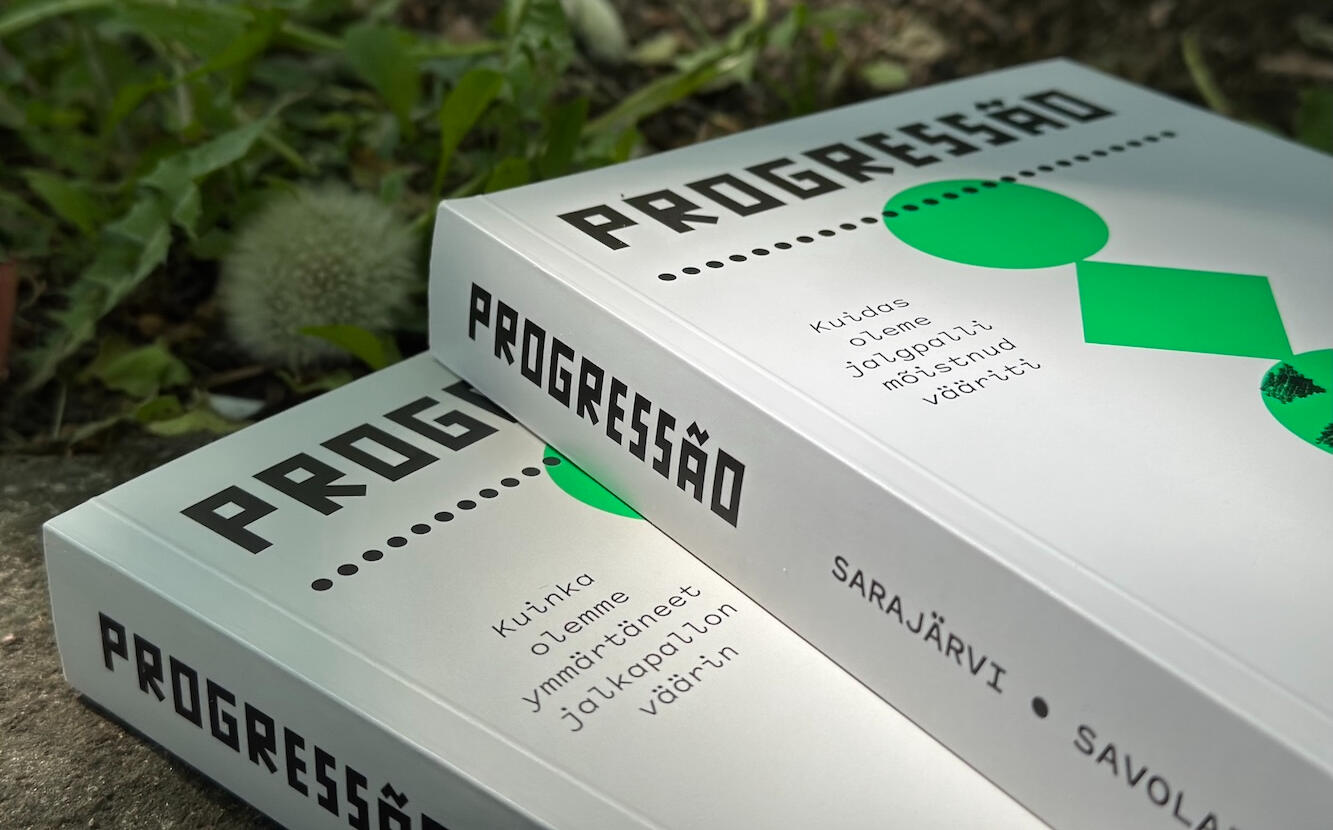
“Progressão – How We Have Misunderstood Football” is the perfect book for anyone who loves the game and wishes to understand its essence in a deeper, wiser and more sophisticated way.We challenge some of the most persistent assumptions in global football: That skill is an individual possession, that technique can be separated from context, and that learning follows linear and mechanical progressions. It does not.We see that the modern football is now experiencing a conceptual turning point. As the game becomes faster, more complex, and more studied, the traditional language of terms like “technique”, “IQ” and “decision- making” no longer explain what happens on the pitch. That’s why frameworks like ecological dynamics matter.We know that federations, league organizations and football clubs around the world are currently re-evaluating how players learn, how teams coordinate, and how performance emerges in real environments. At this exact moment, a scientifically rooted, coach-friendly, human-centered reframing of football skill is not only relevant. It is required.We feel that Project Progressão gives the international football community conceptual tools to understand skill as it truly is: Dynamic, relational and information based.The book – targeted for coaches, players, fans and officials alike – takes our readers across four continents and multiple eras from junior tournaments to the international elite game of modern football offering new perspectives shaped by science yet written with emotion and clarity.“Progressão – How We Have Misunderstood Football” is not just exceptionally ambitious book about football but also about the life itself.
“Progressão – How We Have Misunderstood Football” was published in Estonian in 2024 and in Finnish 2025. The new updated English edition will be available globally soon.
ORDER YOUR BOOK:
”If you're looking for a book that challenges your thinking about football and life — this one is for you.”Tuukka Kotimäki, Urheilulehti"The authors' passion, deep interest and genuine commitment to the topics shine through on every page."Erkko Meri, Apu360

PODCAST
OUR WEEKLY SPOKEN WORD HAS A STEADILY GROWING GLOBAL AUDIENCE THAT REACHES
6 CONTINENTS
We publish a new episode every Tuesday, regularly featuring a wide range of interesting guests from the global football community and sports academics.Football-wise we cover everything from ecological dynamics, defensive tactics, offensive set pieces, balanced formations, latest coaching trends, experimental training methods, historical incidents, future megatrends, correct player positions and the importance of understanding what skill actually means and why.Occasionally we also discuss about arts, science, music, film, design, literature and any other form of culture, because we strongly believe that Progressão is life.What we say clearly resonates and so far our podcast has been downloaded hundreds of thousands of times in six different continents throughout the world.Thank you for listening.
Latest episode:
LECTURES
OUR UNIQUE EDUCATOR POSITION COVERS FOOTBALL, SPORTS, CULTURE AND ACADEMIC COMMUNITIES EVERYWHERE
From Portugal to the Nordics and beyond, Progressão is a frequent debater, lecturer, mentor, listener, commentator and a speaker in various football and other sports related events all around the world.Since 2019 we have collaborated with universities, federations, associations, leagues, clubs and other similar organizations offering out unique views on ecological dynamics and skill in football.

PERSPECTIVE
OUR NEUTRAL FINNISH ANGLE TO THE COMPLEX GAME THAT WE OBSERVE WITHOUT ANY SELFISH BIAS
The Project Progressão origins from Finland, a nation with a fragile football tradition, and therefore we have no rigid dogma to protect. We have worked across four to five continents and within elite club and national team environments and spent years between worlds: Inside high-performance football, yet outside the heavy traditions that define it.We believe that the distance has become our advantage. It has allowed us to question assumptions others rarely see, and to combine science, practice, and philosophy in a way that feels both grounded and refreshing. We operate not from the center of world football, but from its edges, observing and questioning, working along a path shaped by curiosity, independence and practice.We are confident that as Finns we can indeed better argue why we as humans have previously misunderstood football.
“Progressão – How We Have Misunderstood Football” was published in Estonian in 2024 and in Finnish 2025. The new updated English edition will be available globally soon.
ORDER YOUR BOOK:
"Progressão — A book that gives you a whole new picture of football.”Madis Kalvet, Delfi"Nothing like it has been written in Finland before — and likely won't be for some time."Tuukka Kotimäki, Urheilulehti
AUTHORS
THE THREE CORE MEMBERS OF THE PROJECT PROGRESSÃO TEAM ARE

Football coach, researcher, and former player whose career has taken him across four continents, working with elite clubs and national teams. Originally from Northern Finland, he holds a PhD from the University of Lisbon, where his research focused on football skill, coaching, and Ecological dynamics. Jani’s work sits at the intersection of science, coaching practice, and human development, exploring how players and teams achieve high performance through their ongoing engagement with the environments around them. His journey in football is also a path into understanding life, learning, and what it means to become skillful.
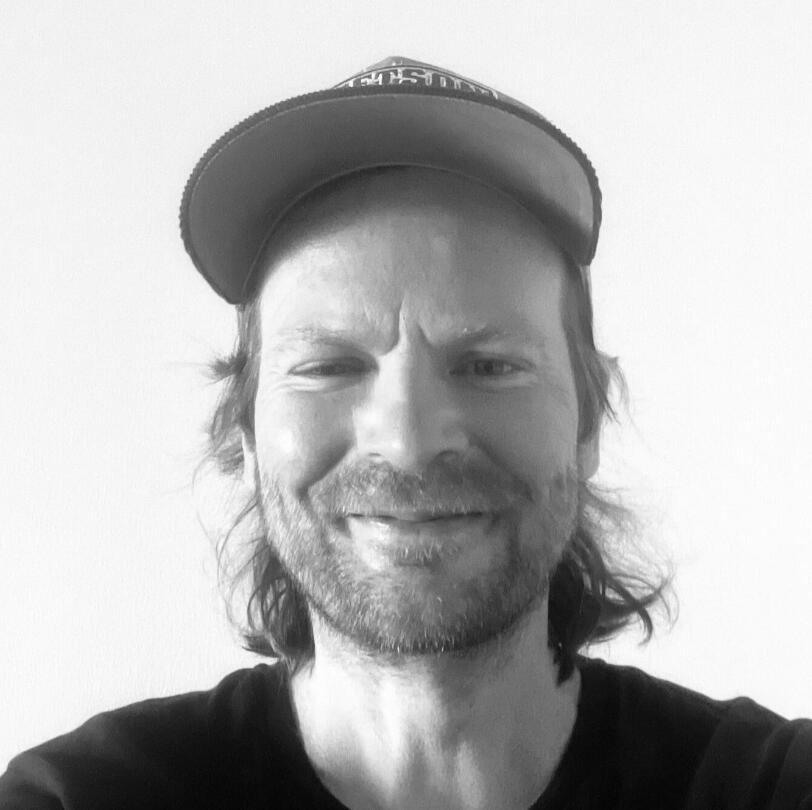
A Finnish-born and US-educated Independent Creative Director & Global Brand Consultant who has led Project Progressão’s tone of voice, branding and storytelling from day one. Also a former youth national team player, whose pro career ended due injuries before it had even begun, and who then became NSCAA Div 1 Scholar first team All-American at the University of Kentucky, who still understands tactics, skills and nuances but is more interested in football as a cultural, societal, environmental, sociological and anthropological study that is helping making sense out of human nature, learning and behavior. For Antti J. Progressão means eternal observing of everything.

Harriet huhtakangas
ProducerContent CreatorMaster of Health Sciences
A Finnish football enthusiast and lifelong fan whose relationship with the game has run through her entire life. She played for her club for over fifteen years, representing the Central Ostrobothnia regional team and competing at Finland's second-highest league level, alongside futsal in the domestic top tier. With the Finnish national team, she won The Barents Winter Games in 2014. She also has experience coaching young players. Harriet holds a Master's degree in Health Sciences, bringing a structured, research-driven approach to her work behind the scenes at Progressão. For Harriet, Progressão means togetherness — a shared project built on enthusiastic, collective work.

CULTURE
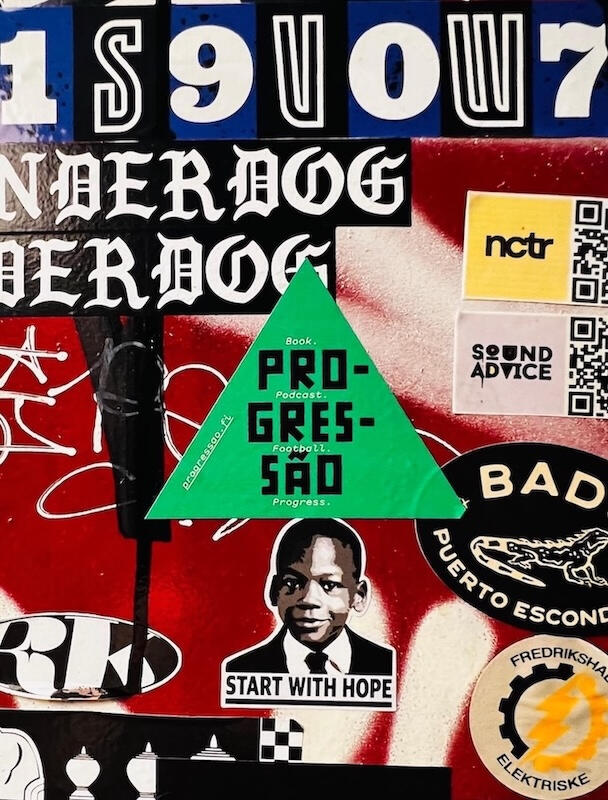
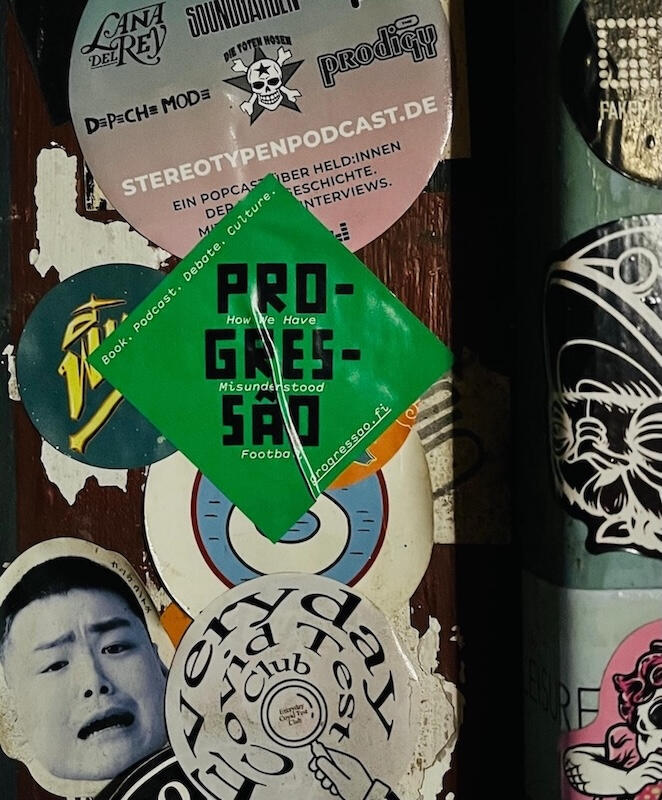
THESE STICKERS CAN BE FOUND ALL AROUND THE WORLD BECAUSE WE BELIEVE PROGRESSÃO IS LIFE
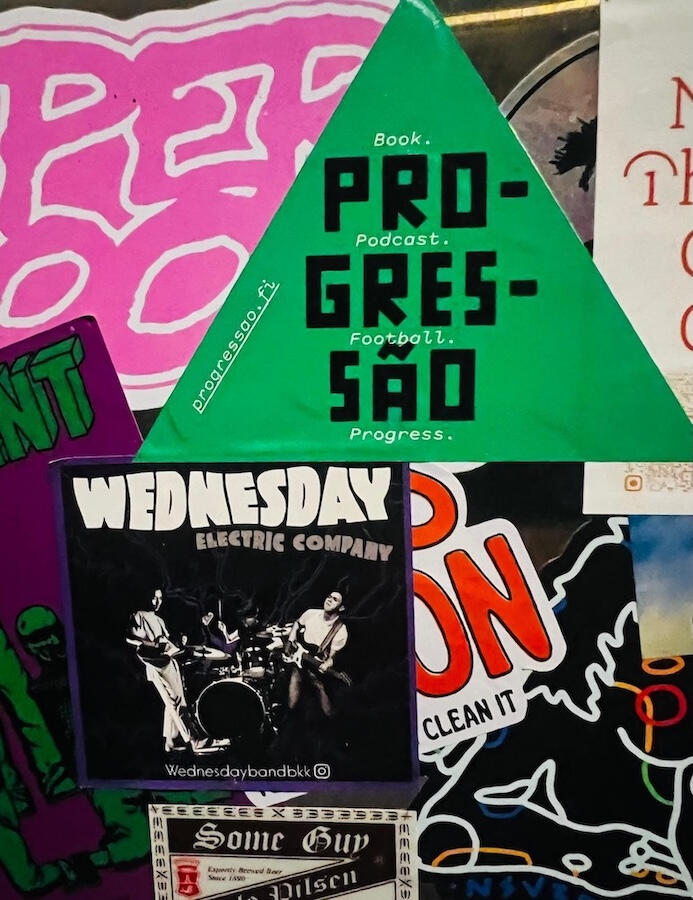
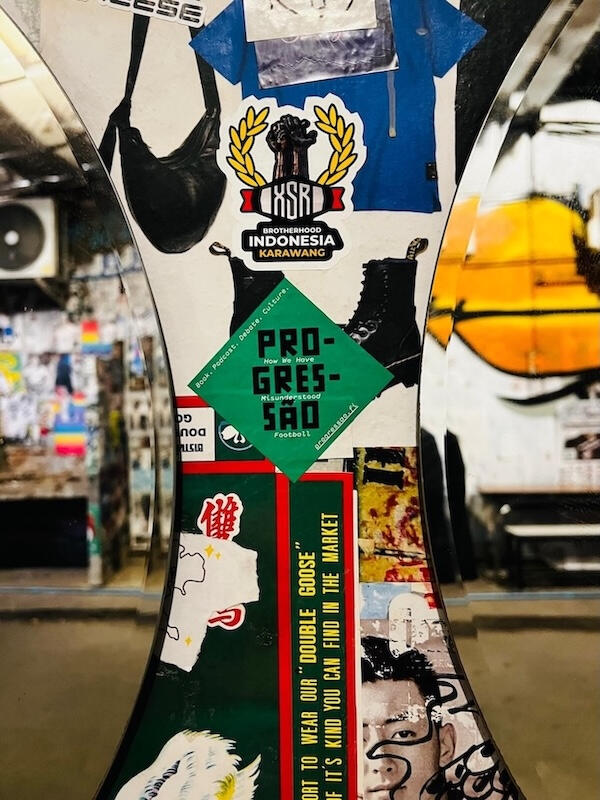
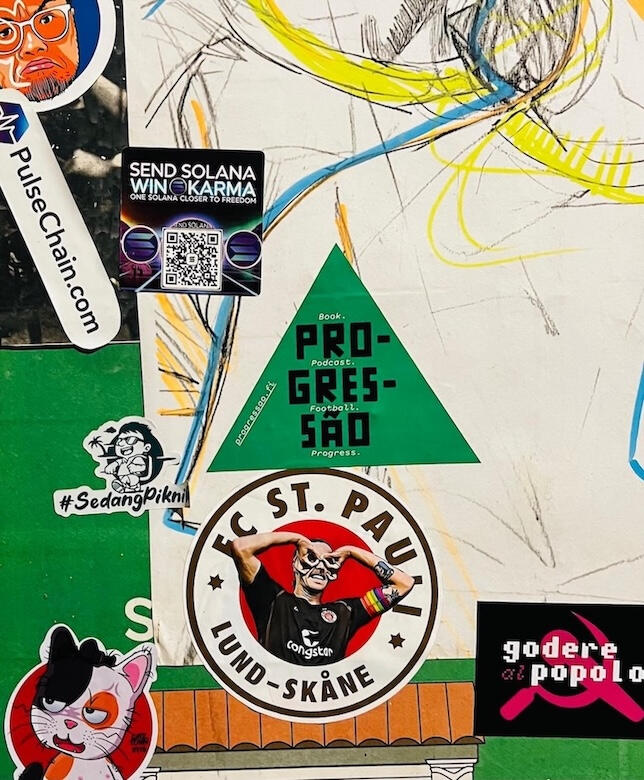
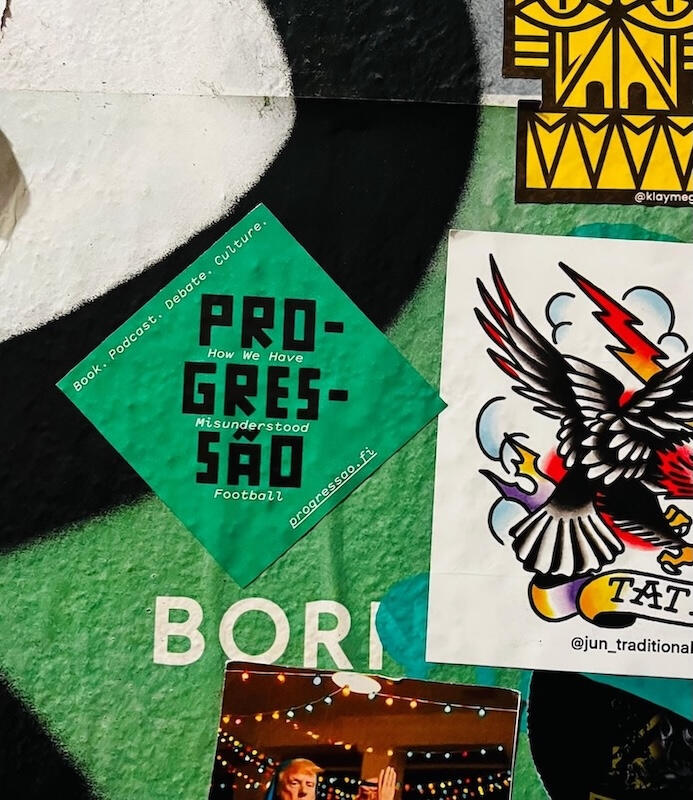


©PROGRESSÃO 2026.
Reading Football
27 SEPTEMBER 2026
"When you are born in Uruguay, the first gift from your father is a ball."— Gustavo Banales, as cited in Scottish FA (2025)
Eleanor J. Gibson spent decades studying how animals and people learn. In the famous visual cliff experiments, she placed newborn goats and human infants on a glass-topped table. One side showed a shallow surface just beneath; the other dropped away into what looked like a steep fall. The newborn goats refused to step onto the deep side, and so did the infants, once they could crawl. Perception, Gibson concluded, is not passive. It is tied to action from the very beginning of life. We perceive what we can do, and what we cannot.She applied the same logic to reading. Learning to read, she found, is not about memorizing rules. It is about learning to perceive differences — between b and d, between meaningful patterns and noise. As readers improve, they become more efficient at picking up exactly the information they need.Her studies were conducted decades before a question began troubling development economists: why even the best reading programs in low-income countries barely moved the needle. Schools improved. Teachers trained. High-level interventions deployed. And still, children couldn't read. Gibson didn't study this directly, but her findings shed light on it. The programs arrived too late. Reading doesn't start in school. It starts much earlier, at home.Children who grow up surrounded by books, in families where adults read, begin to understand what reading is before anyone teaches them a letter. They absorb its logic, get curious, discover its uses on their own. By the time they enter a classroom, they are not beginning, they are continuing. "Children growing up in a culture that provides appropriate material and opportunities discover a great deal about writing, how it is constituted and what its uses are, by themselves." And: "One doesn't teach reading to someone. Rather, that person learns to read."Football is the same.The Scottish FA reviewed its youth development in 2025 and found that for decades, almost all investment had been aimed at the 12–16 age group. Academies, programs, licensed coaches, GPS data. It hadn't worked. So they looked at where development actually happened. Messi. Ronaldo. Ronaldinho. Iniesta. Without exception: a ball in the house before age three. A father, a mother, a grandmother. Months and years of play in a living room, a yard, a street corner, before any organised session. "All we have to do is go and pick them up," said a director of a top Brazilian academy. "No club has to worry about what they've been doing up to the age of thirteen."The football industry pours money into the wrong end of development. It invests in what is visible: academies for teenagers, elite facilities, credentials. The foundational layer, a ball in the living room, a parent who plays with their child, a street where children can roam, receives almost none of it. This is what professionalization does.Gibson again: "The moral seems to be the wisdom of providing young children with an environment supplied with plenty of literature of the kind one wants them to be curious about, and letting them explore a variety of reading material with adults who are ready to answer questions and provide role models by reading themselves and to their children."Replace literature with footballs. Replace reading with playing. The most powerful development facility in the world is a ball in the house and a parent who pays attention. The football world knows this. And continues to build academies.ReferencesSpelke, E. S. (2024). Eleanor Jack Gibson. A life in science. Annual Review of Developmental Psychology, 6, 1–34.Scottish FA. (2025). Review of Youth Development in Men's Football.

Creation
27 AUGUST 2026
There was an artist who hit a dead end. Artistic, even spiritual. He couldn’t compose anymore and this lasted for years.And then one calm day, about to leave the house with his family, he felt a need to sit down at the piano. One quiet moment, after all those years of fog and searching. Searching for his own way of composing, of being. What came out of that moment was so new, so still, so beautiful that the world seemed to pause and listen. He had found tintinnabuli, the ringing of small bells. A completely new way of feeling life.Those in power didn’t understand it, or feared it, because it was too spiritual, too free. He had to leave. He was fortunate, as in his country, those who were made to leave usually went somewhere cold and desolate and did not return.He went west, but in the beginning, the West didn’t understand his music either. The sound was too quiet, too still. The world was in turmoil. People were suppressed, afraid, loud. Arvo Pärt responded with radical simplicity. Small bells ringing.The journey was not easy. But on the path, Arvo met someone who understood him and his music, and helped it reach the world. And it did. Now, years later, Pärt is widely considered one of the greatest living composers. His music brings solace to people who have never even heard of Estonia.From a small country. Under occupation. Starting over in exile. With nothing but a new and quiet sound. It is hard to see what could be. But it is possible to place ourselves where creation can emerge. Estonian football has yet to find its tintinnabuli. Maybe you. Maybe we?

Via Negativa
26 JULY 2026
“no walking, no running, no laying on the floor, no hanging out in the body, no stretching, no floppy arms or hands, no deliberate loss of grounding, no noodling, no prolonged narrative movement, no obvious sequence of movement, no prolonged body memory apparent, no time to explore, no obvious frontality, no need to be creative or unique, no obvious adrenalin driven movement, no apparent inner timing driving your dancing, no hesitation or reconsideration”
— Deborah HayA teacup, the work of a master, holds the maker’s whole character in two or three brushstrokes. The same mastery shows in a defensive line with its height, orientation, timing, earned by repetition. To work at that level, a professional needs principles to stand on. Without them, good work doesn’t survive a storm. This piece is about one principle, too often neglected in coaching.Via negativa has been used across centuries, in, among others, the Christian and Muslim traditions, by people wishing to learn who God truly is. In this way of thinking, built on negation, the starting idea is that you strip qualities away from God, and that in this way you can eventually describe the true God. The principle has also been applied to human life, where quality of life has been improved by stripping away unnecessary things. For example, instead of adding healthy food and more sleep, people have quit smoking and drinking, and life has improved significantly without adding anything to it.A team’s playing model can serve as an example of via negativa in team sport. We usually want to make the playing model more effective by adding things to it. We want to add qualities or actions to make the playing better. The focus tends to be on the “positive” side of things, because we are reluctant to forbid players from doing something. It might hurt their feelings, and many of today’s coaches, despite their good pedagogical skills, are not willing to face difficult moments with their players. This kind of thinking leads to dishonest interaction. Players are given hints about what we would want them to do. We act pseudo-honestly, which leads to a web of lies. In reality, players prefer honesty and directness, even when it is occasionally painful.Forbidding and adding can coexist. But right now, we only add, and it’s costing us. Stripping actions away from the playing model helps develop the game, because it allows the removal of unnecessary actions that hinder the team’s play. When you constrain and strip down a complex system, you can get something beautiful and effective in return. Good collective play, for instance.This also matters for how time is used, because instead of guessing around in a gray area, players are simply forbidden from doing certain actions, and things become clear. They become clear in the same way they did for the top choreographer Deborah Hay, who, after watching a Finnish contemporary dancer move — and in particular a certain incidental little step — said, “I feel like you don’t need to do that anymore.”By using the lateral thinking developed by the English scholar Edward de Bono, and by placing oneself in a new, possibly arbitrary position, sport can learn from other fields. Jerzy Grotowski, the late, progressive Polish theatre director, used via negativa in the sense of an elimination technique, in which the aim was not to add techniques but to strip away obstacles. Actors sought to learn to be perfectly present in the moment by stripping away everything unnecessary from their thinking and action. In this way, according to Grotowski, they could find the true essence of theatre and “holy actorship.” According to Grotowski, the perfect actor was not a prostitute actor who sells their body, but a doer who sacrificed their body for acting. Only the holy actor was capable of sacrificing their psychophysical blocks and doing holy work.The same operating model can be applied to many different ways of being in a team, training, and playing. When we feel that a certain kind of behavior is not good for the team’s functioning, instead of endless discussion and operating in a gray area, we can simply forbid it. “I feel like you don’t need to do that anymore.” Parents, among other means, use the same operating model in raising children. A clear, straight-backed “no” is a far better option than endlessly wading through a swamp of guesswork.Via negativa is not negative in the sense that applying it is meant to find God, make life better, or make a playing model more effective. In team play, the purpose is to strip the unnecessary actions out of the game in order to develop the team’s play. Strip the lights and the clutter off the Christmas tree, and you can see the real tree. Another contemporary dancer said to Deborah Hay, at the start of a big project, “before work like this, I need to warm up and get into the right feeling.” Deborah answered, “okay, for the next three weeks, I want you to imagine that that’s just a thought you have about yourself.”Strip away the warm up. Strip away the hint, the maybe, the almost. What’s left is the work itself.

Against the universal football language
25 JUNE 2026
Seven continents. Thousands of cultures. Thousands of languages.
A thousand ways to say “I love you.” A thousand ways to say “what a beautiful pass.” Worth asking: why do so many ways exist to say the same thing?Many reasons, probably. But here’s one: maybe the same thing is not the same thing. Maybe a Brazilian feels a beautiful pass differently than a Finn does. Maybe love in Lisbon is not love in Tallinn. The feeling changes shape in different environments, and the word changes with it.Ask ten people what a football game is. You’ll get ten different answers. Some mention goals. Some mention beauty. Some mention war, or art, or childhood, or money. This is inconvenient, of course. When the Brazilian and the Finn sit down to discuss the same match, they are not quite discussing the same match. They feel the game differently, and the words reflect this. Talk becomes a small misunderstanding. Or, a talk becomes a rich way of seeing and exchanging ideas of a phenomenon.However, someone wants to fix this problem of diversity. One universal football language. One word, one meaning, understood the same everywhere. Then everyone will finally understand each other.No.Language is not a machine part. It isn’t meant to be standardized, mass-produced, interchangeable. Language is malleable, complex, a process rather than a product. It grows out of soil, weather, history, hunger, joy, defeat. It’s as rich as the culture that grew it, and no richer.A football game is not one thing wearing many disguises. It is a thousand things, each true in its own place. The Brazilian’s joga bonito doesn’t lie when it disagrees with Finnish sisu. Neither does Portuguese improviso, or English grit, or whatever word a street in Banjul uses for a nutmeg that makes the whole block laugh. They are all true. None needs correcting into the others.We don’t need to tame this diversity into one boring definition. We don’t need a Football Esperanto — gray, obedient, easy to translate, impossible to feel.Keep the thousand words. The day we all say the same thing, we’ll have nothing left to say.

©PROGRESSÃO 2026.